Zadar's Old Town is a peninsula about six hundred metres across, which means the whole of what follows fits inside a square kilometre and none of the walking is hard. What the size hides is the density. Almost nowhere else in Europe can you stand on an open Roman square, with a ninth century church built out of its rubble on one side, a Romanesque cathedral on the other, Venetian walls behind you and a set of marble steps that play the sea two minutes ahead.
This route runs clockwise from the Land Gate and finishes at the tip for sunset, because the sunset is not optional here and everything else is easier to schedule around it. Done at a normal pace with a long lunch it fills a day. Done briskly it is a morning, which is what a cruise passenger gets.
Start at the Land Gate
Come in from the mainland side, through Kopnena vrata. The gate is a triumphal arch of 1543 by the Venetian architect Michele Sanmicheli, with the winged lion of St Mark over the central opening, and it is still the way most people walk into the city. The circuit it belongs to joined the UNESCO list in 2017 along with the other Venetian defences around the Adriatic.
Outside it lies Fosa, the small harbour where the boats moor below the walls. It is worth two minutes before you go through, partly for the view back at the gate and partly because you will want to know where it is when you come back for dinner.
Five Wells Square and the bastion
Through the gate you are immediately at Trg pet bunara. Five ornate stone well heads stand in a line across it, built in the sixteenth century over a cistern the Venetians dug to hold the city's water through the Ottoman sieges. The Captain's Tower stands at one corner, five-sided and the only tower of the older circuit still at full height.
Climb the steps onto the bastion behind. The park on top, laid out in 1829, is the oldest public park in Dalmatia and the one piece of shade inside the walls; its promenades run along the top of the fortification and look down over the wells, the tower and the roofs. If you are here in July, remember where it is.
Kalelarga
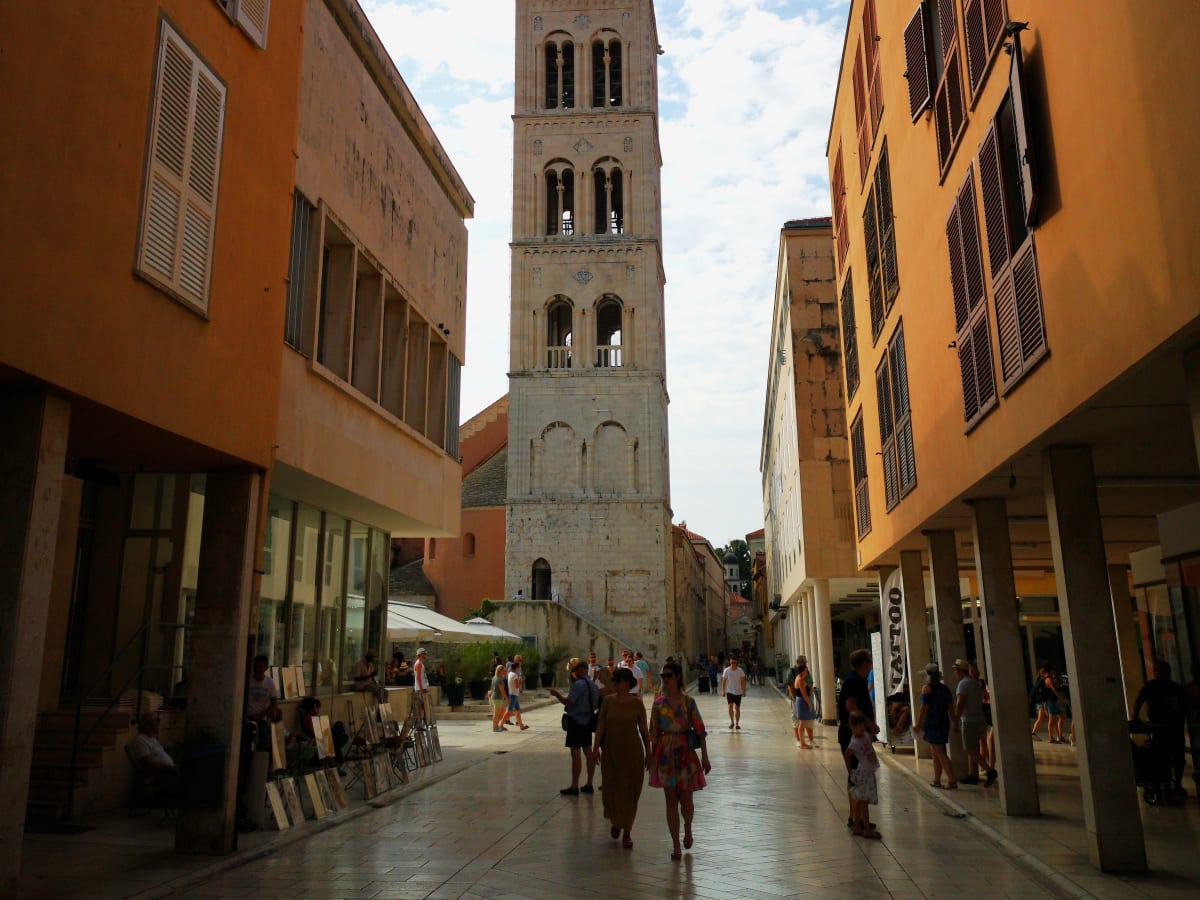
From the square, walk into Siroka ulica. Nobody calls it that. It is Kalelarga, from the Venetian for broad street, and it has been the spine of the city for two thousand years, following the line of the Roman decumanus. It is not long. Walking it end to end takes five minutes, which the city compensates for by walking it four times a day.
This is where the coffee happens, and coffee here is an hour rather than a takeaway. If you want to understand Zadar faster than any museum will teach you, sit on a terrace at eleven in the morning and watch how long everyone else stays.
The market, if it is still morning

Just off the north side, under the walls, the city market runs in the open. Fruit and vegetables from the Ravni Kotari fields inland, olive oil, honey, dried figs, sheep cheese from Pag and homemade rakija, mostly sold by the people who grew or made it. The covered fish hall alongside opens early and finishes when the catch is gone.
It is a twenty minute stop that changes how the rest of the day reads, because every menu you look at afterwards is drawn from what you have just seen on the stalls. It is also the answer if you are self-catering: this and a bakery will feed two people for less than one restaurant lunch.
The forum
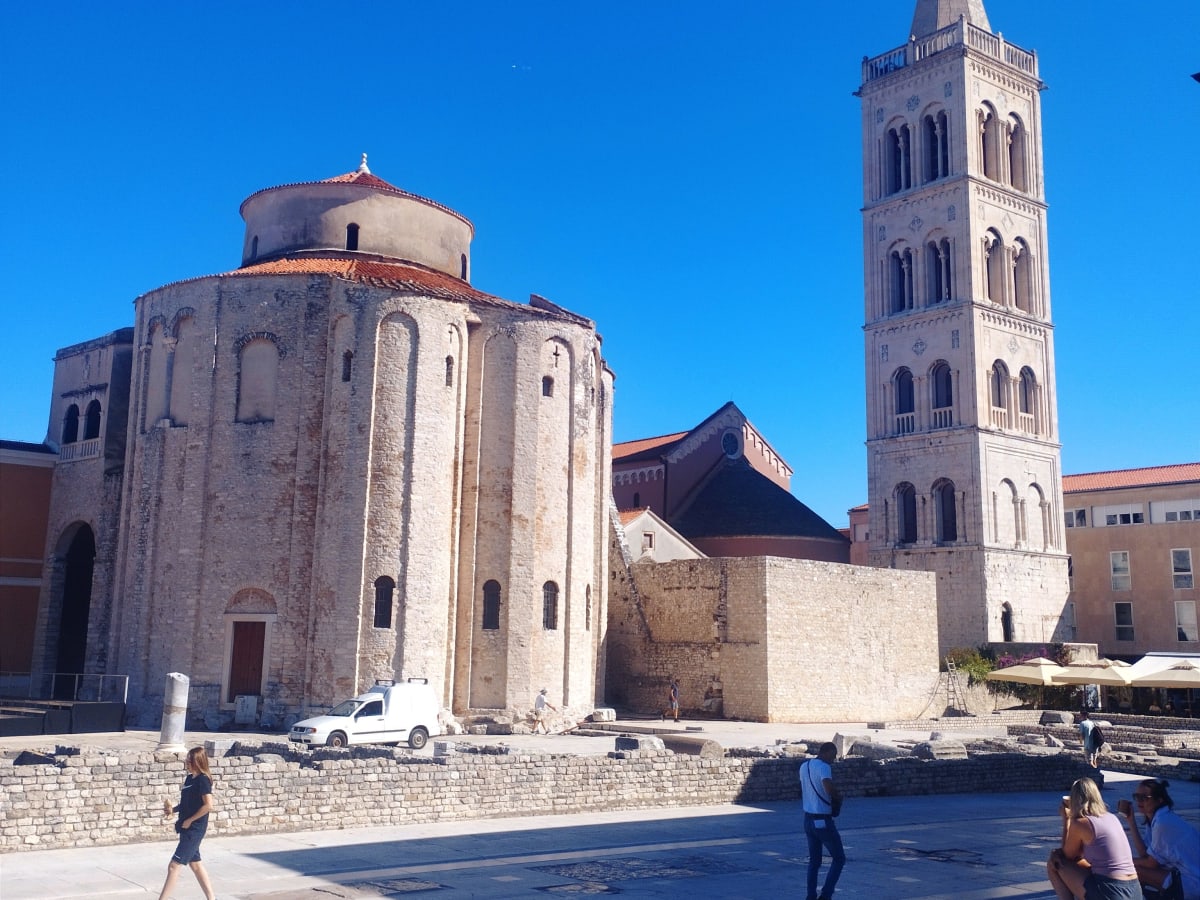
Kalelarga delivers you to the Roman forum, and this is the centre of everything. Laid out in the first century under Augustus, it is the largest Roman square on this side of the Adriatic and, unlike almost every other, it was never built over. The paving, the column bases and fragments of the temple podium lie open to the sky in the middle of the peninsula. One column still stands at the corner, later used as a pillory, with the chain rings still in it.
There is no ticket and no gate. People cross it on their way to work.
St Donatus and the cathedral
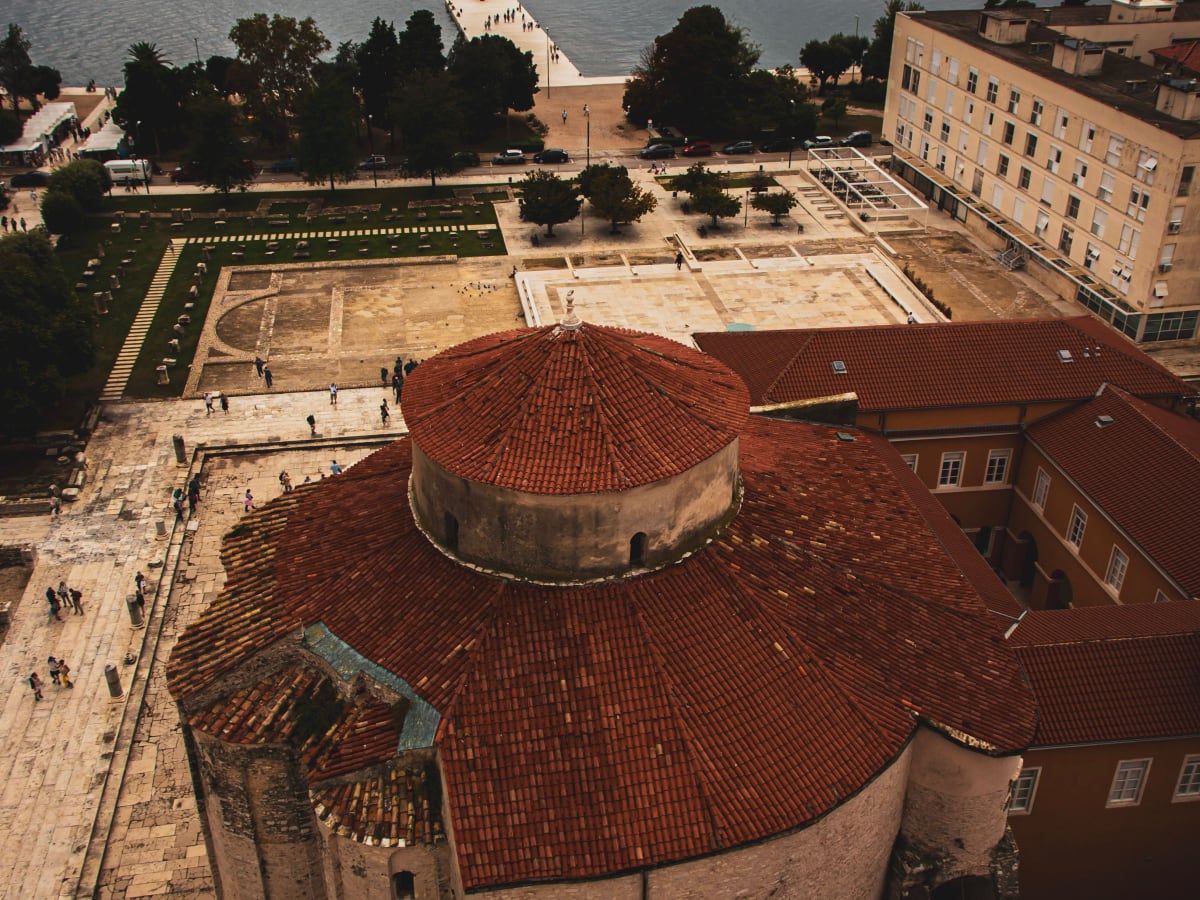
The round church on the forum is St Donatus, begun in the ninth century directly on the Roman square and built partly from its stones; look at the base of the walls and you can pick out column drums and inscribed blocks laid flat. It has not held services for two centuries. The bare stone interior carries sound extraordinarily well, which is why it is used for early music concerts in summer, and the ticket is bought at the door.
Beside it stands the cathedral of St Anastasia, the largest Romanesque church in Dalmatia, with a west front of blind arcades and two rose windows. Go up the bell tower. It costs a few euros, the stair is long enough to feel it, and the top is the only place in the city that puts the forum, the round church, the tiled roofs, the channel and the islands into a single view. In a flat town this is the view.
Across the square the Benedictine nuns of St Mary have held their site since 1066. The museum attached to the convent shows the Gold and Silver of Zadar, the reliquaries and church treasure the order kept safe through every siege the city survived. It is a small collection and a genuinely remarkable one.
Lunch, and the glass museum
Eat around here rather than on the waterfront, where you pay for the view. The lanes behind the forum hold konobas doing the Dalmatian repertoire: fish grilled over coals and priced by the kilo, shellfish in a buzara of wine and garlic, black risotto, and pasticada over gnocchi if you want the long-cooked thing.
Afterwards, the Museum of Ancient Glass is five minutes away and holds one of the larger collections of Roman glassware in Europe, recovered from the graves and villas of Roman Dalmatia. What separates it from a case-and-caption museum is the workshop: glassblowers work in the building, so the technique behind the objects is demonstrated rather than described. The Archaeological Museum on the forum square covers the same ground more broadly, from prehistory through the Liburnians to the medieval town.
The Riva, and then the tip
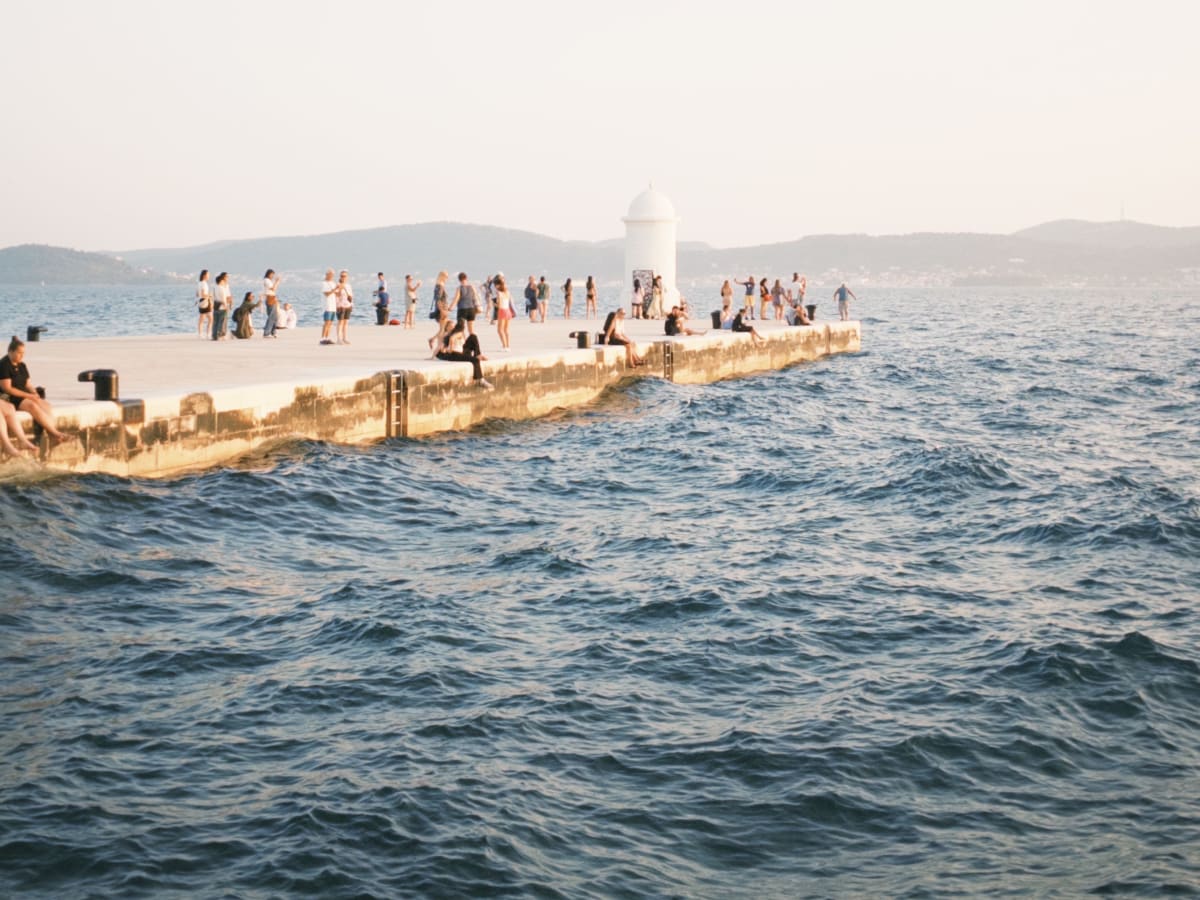
Come out onto the Riva, the promenade along the northern edge, in the late afternoon. This is the stage on which the city performs its evening: the whole town walks it at roughly the same hour, and the view across the channel to the island of Ugljan is what everyone is walking towards. Alfred Hitchcock called the sunset here the finest in the world, and the tourist board has never once let go of the line.
At the far tip, two modern installations do the closing act. The Sea Organ is a set of wide marble steps with pipes built beneath them, so the swell pushes air through and the steps sound; the tune changes with the weather and the louder the sea, the louder the organ. Beside it, the Greeting to the Sun is a disc of glass panels twenty two metres across set into the paving, storing daylight and spending it after dark as a light show.
Neither charges anything. Sit on the steps about forty minutes before sunset, because by twenty minutes before there is nowhere left to sit.
Tours & Day Trips in Zadar
Boat trips, day tours and skip-the-line tickets around the city and the islands, via GetYourGuide.

Guided Walk Through the Old Town
The forum, St Donatus and the walls on foot, with a guide to explain what you are looking at.
Check availability
Ninety Minutes by Tuk-Tuk
A short circuit of the peninsula and the waterfront for anyone who would rather not walk it.
Check availability
Walking Tour With a Virtual Reality Headset
The Roman and Venetian city rebuilt around you through a headset, then walked in the present.
Check availability
If you have a second day
Add the water. The archipelago in front of the city holds more islands than anywhere else on the Croatian coast, Ugljan is twenty minutes away as a foot passenger, and the Kornati national park is a full day out. If you would rather stay on land, Nin is half an hour north west and holds a ninth century church often called the smallest cathedral in the world, salt pans still harvested by hand, and three kilometres of real sand.
Doing it in reverse, off a cruise ship
Ships berth at Gazenica, three kilometres south east of the peninsula, and the shuttle or a taxi takes ten to fifteen minutes to the walls. That puts most passengers into the Old Town by mid morning with five or six hours ashore, which is enough for everything above except the leisure.
The order changes though. Cruise calls arrive when the forum is at its busiest and leave before sunset, which is precisely the wrong shape for a city whose best hour is the last one. If your ship sails at six you will not see the Greeting to the Sun lit, so trade it for the bell tower climb early, while the light is good and the queue is short, and spend the saved half hour on the Benedictine treasury rather than on the waterfront.
Anyone with a short call should also skip the market, which is at its best between seven and ten and largely packed up by the time a ship's passengers reach it.
Where the day usually goes wrong
Three mistakes account for most of the disappointment visitors report here.
The first is treating Zadar as a half day stop between Split and Plitvice. Three hours buys the forum and a coffee, and misses the reason to come.
The second is arriving at the Sea Organ at sunset itself and finding several hundred people already on the steps. Forty minutes earlier is a seat; twenty minutes earlier is standing at the back.
The third is booking a car for a city stay. The peninsula is pedestrian, the parking is outside it and charged by zone, and everything in this guide is on foot. Hire a car for the days you leave the city, not for the days you are in it.
Practical notes
Everything above is walkable and none of it needs a car; a car is a liability inside the walls, since the peninsula is pedestrian and the lots outside it fill by mid morning in summer.
Cash still moves faster than a card at the market and in the smaller konobas. Most churches ask for shoulders and knees to be covered. The bell tower closes earlier than you would like in shoulder season, so do it before lunch rather than after, and leave the Riva for the end of the day where it belongs.


