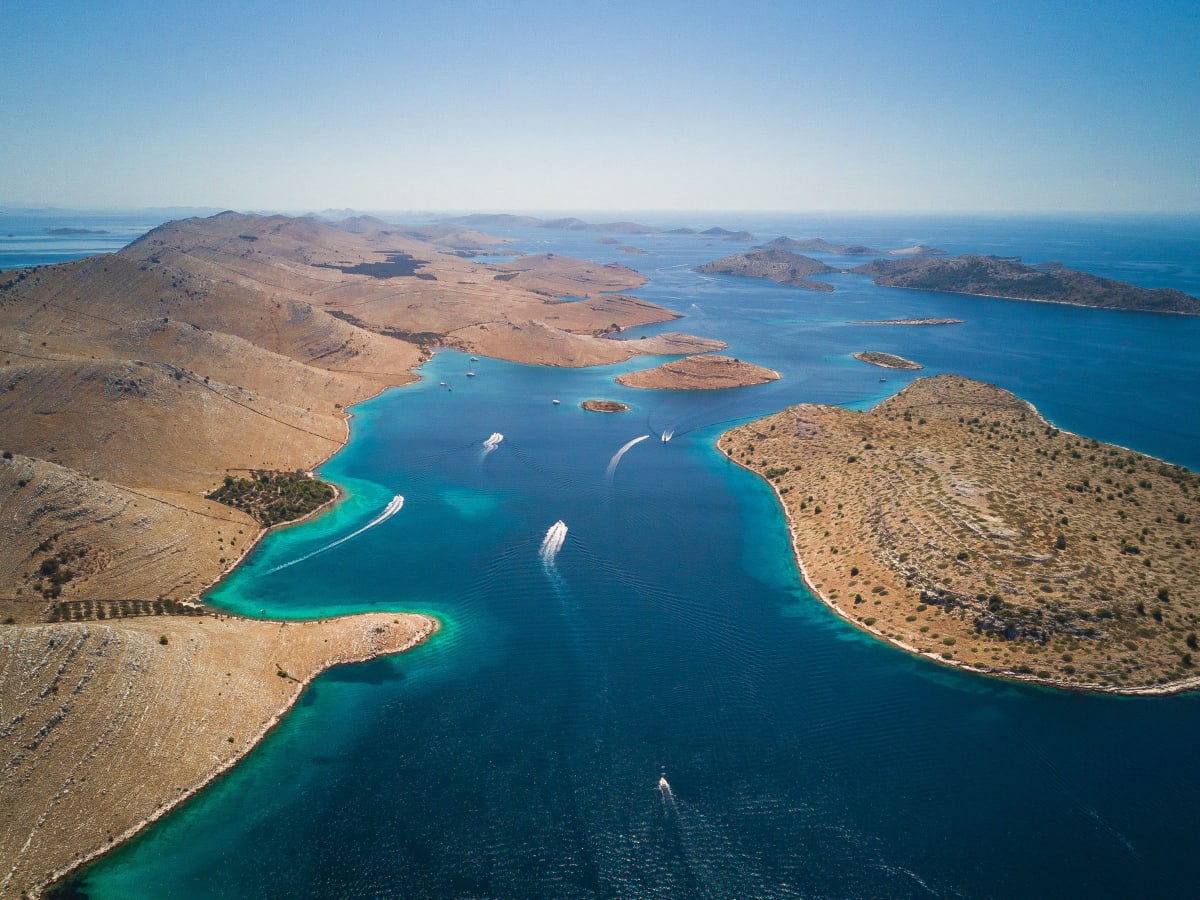


More islands lie in front of Zadar than in front of any other city on this coast: the archipelago runs to about two hundred and forty islands, islets and reefs, of which a couple of dozen are inhabited. From the Riva you are looking at Ugljan, close enough to see cars moving on it, and behind that lies everything else.
The single most useful thing to understand before you plan anything is that boats leave from two different places, for two different reasons, and confusing them will cost you a morning.
Two harbours, two kinds of boat
The car ferries and the scheduled passenger boats leave from Gazenica, about three kilometres south east of the peninsula. The port moved there some years ago, and the international sailings and cruise calls use it too. It has ticket desks, parking and a waiting hall, and it is fifteen minutes from the Old Town by bus or ten by taxi.
The Riva, the promenade along the peninsula, takes small excursion craft only: the day boats to the Kornati, the sunset cruises, the little barkajoli rowing boats that have crossed the harbour mouth for centuries. If a website tells you your ferry leaves from the town quay, it is out of date.
Allow half an hour to reach Gazenica, and considerably more with a car in August, because the queue for the ramp forms well before departure.
Ugljan: twenty minutes, and the easiest day out

Ugljan is the long green island directly opposite the city and the obvious first trip. As a foot passenger the crossing takes about twenty minutes and costs a few euros, which makes it cheaper than lunch and the single best value day in Zadar.
The island is olive groves, small harbours and a road that runs its length. Preko is where the boats arrive; above it stands the Venetian fort of St Michael, a walk or a short drive up, with a view back across the channel that puts the whole peninsula in front of you. Kali and Kukljica, further south, are working fishing villages that supply a good share of what the city's fish restaurants sell.
Take a bicycle if you have one; the island rewards it and the ferry carries them for very little. Otherwise a bus meets the boats, and a taxi on the island is a small local operation rather than a rank.
Pasman, and the bridge trick
Pasman continues south from Ugljan and is joined to it by a bridge, which is the detail people miss. Ferries run to Tkon on Pasman directly from Biograd, south of Zadar, but from the city you can also reach it by crossing to Ugljan and driving or cycling down.
It is quieter than Ugljan and shallower on its landward side, with sandy-bottomed bays that warm early. The Benedictine monastery on Cokovac hill above Tkon is the one piece of formal sightseeing, and the rest of the island is beaches, small konobas and very little traffic.
Dugi otok: the long island, and Sakarun
Dugi otok means long island and it takes about an hour and a half to reach. It is the one that appears in photographs: Sakarun on the north coast is a long shallow bay with pale sand and water that goes an implausible turquoise, and it earns the trip even on a day when the rest of the island is closed.
At the southern end, Telascica bay is a national park in its own right. Cliffs on the seaward side drop over a hundred and fifty metres, and behind the shore lies Mir, a salt lake warmer than the sea and thick with the mud people come to smear on themselves. Most visitors see Telascica as part of a Kornati boat day rather than on a ferry, which is the sensible way to combine them.
Going independently means checking the return sailing before you go anywhere. This is not an island with an hourly boat.
Iz, Rava, Molat and the small ones
Beyond the main three lie the small inhabited islands: Iz, Rava, Molat, Silba, Olib, Premuda. These have a few hundred residents each, a shop, a church, a couple of konobas and no cars to speak of. Silba bans them outright in summer.
They are not day trips in any comfortable sense, because the timetables are built for islanders getting to Zadar and back rather than for visitors doing the reverse. What they are is somewhere to spend three days doing nothing at all, which is a different and perfectly good holiday.
The Kornati: the day everyone takes
The Kornati archipelago is the reason most visitors get on a boat here. Eighty-odd bare limestone islands in a national park, almost no soil, no fresh water, barely any buildings: George Bernard Shaw's line about the gods making them out of tears, stars and breath is quoted on every leaflet in the city, and it is quoted because the landscape genuinely does not look like anywhere else.
Day boats leave from the Riva and run twelve hours, usually taking in Telascica as well, with lunch aboard and two or three swim stops. Park entry is normally included in the ticket but worth confirming, since it is charged separately by some operators.
Weather decides everything. In a strong bura the trip is either cancelled or unpleasant, and the good operators cancel. Booking through an agency counter in town rather than online has a real advantage here: they know the forecast, they know which boats sail in what conditions, and they can move you to another day.
Tours & Day Trips in Zadar
Boat trips, day tours and skip-the-line tickets around the city and the islands, via GetYourGuide.

Kornati and Telascica by Boat
Full day through the national park archipelago, with Telascica bay and swim stops.
Check availability
Kornati and Telascica With Lunch Aboard
The same Kornati and Telascica run, with lunch and drinks aboard rather than a packed sandwich.
Check availability
Dugi Otok, the Wreck and the Sea Tunnel
Half day to Dugi otok taking in the sunken ship and the sea tunnel, with time in the water.
Check availabilityHiring your own boat
A skipper's licence gets you a small open boat for the day, and the near islands become yours. Operators want a licence and a deposit for anything self-drive, and will refuse to send you out when the wind is up, which is a sign of a good operator rather than a bad one. Fuel is usually extra and charged on return.
Without a licence you can still hire, but with a skipper, which costs more and buys local knowledge about where to anchor and which channel to avoid. For a first time on this water, that is money well spent.
Reading a Croatian ferry timetable
Timetables are published by season, and the winter service is genuinely sparse, so check the sailing for the day you travel rather than the week before. Sailings are listed by departure point rather than by island, which confuses matters when an island has two ports.
The second rule is to check the return before committing to the outbound. Several smaller islands are served by boats built around islanders coming into Zadar in the morning and going home in the afternoon, which is the exact opposite of what a day tripper needs. On those routes the day trip that looks possible on paper leaves you four hours on a quay, or a night in a village with one guest house.
Car ferries and passenger catamarans are separate services with separate timetables. The catamaran is faster and takes foot passengers only; the car ferry is slower, cheaper and takes everything. For Ugljan the frequent car ferry is the practical choice either way.
What it costs, roughly
Foot passenger crossings to the near islands cost a few euros each way, which makes them the cheapest thing you will do here. Taking a car costs several times that and needs queueing time in summer. A full day Kornati excursion with lunch sits at a normal excursion price and usually includes national park entry, though that is worth confirming rather than assuming.
Hiring a small boat for the day on your own licence lands between the two, with fuel extra and charged on return. A skippered day costs more than either and is the right call for a first outing on this water, because the money buys local knowledge of where to anchor and which channel to avoid.
What to take on a boat day
Water, more than you think, since the Kornati have none and the boats sell it at boat prices. Sun cover that stays on in wind: a hat that leaves in the first channel is no hat at all. A layer for the return, because the temperature on deck at six in the evening bears no relation to the one at noon. Cash for the small islands. And shoes you can get wet, since several swim stops are ladder entries into open water and some landings are onto rough concrete.
If anyone is prone to seasickness, take something before boarding rather than after. The channels between the islands are usually flat; the open stretch out to the Kornati is not always.
Which trip suits which day
A settled forecast and a full day free is the Kornati. A half day, or a day when the wind is up, is Ugljan on the public ferry, which is sheltered, cheap and cancels for almost nothing. A day with small children is the short crossing rather than twelve hours on a deck. And a day when you want the photograph more than the swim is Dugi otok and Sakarun, on the understanding that the timetable rather than your preference decides how long you get there.
Practical notes
Timetables change between the summer and winter seasons, and the winter service is genuinely sparse. Check the day you travel rather than the week before.
The bura, the dry north easterly that funnels down these channels, can cancel a sailing outright and often does in spring and autumn. Build a spare day into any plan that depends on a boat.
Take cash for the small islands. Take water for anything in the Kornati, where there is none. And if you are taking a hire car onto a ferry, book the crossing rather than turning up: in August the ramp fills, and the next sailing may be hours away rather than minutes.


